May 04 • 2026
Wideframe
Stage
Seed
Category
AI Post-Production
Agentic Video Editing
Incubator
Teardown Written By
Shay Van Lue
TL;DR
The Thesis: Wideframe believes that editing should be editing—not prepping.
The Tension: Wideframe is building a horizontal product, but two dominant ICPs are in a tug-of-war while being pushed into a classic YC vertical-growth playbook.
Shay Says: "Why not have your cake and eat it, too? But let's do it without making a mess."
Seed-Stage
Video
Agentic
Post-Production
YC
The Setup
Wideframe is a YC W26 desktop app that organizes, labels, and assembles video footage, memorizes every frame for meaning-based search, can generate AI video from your own footage (not slop), acts as a creative strategist with content trend analyses, and stops just short of buttoning your shirt! 👔
In all seriousness, Wideframe is genuinely useful. As a filmmaker, I see how the founders have skin in the game and I respect their mission to protect the craft of editing instead of replacing it. They’re solving a real universal problem—the massive amount of prep-work that happens before footage ever gets ingested into the timeline.
But here’s the rub: they’ve built a horizontal product—one that could serve a HUGE variety of editors. However, the YC vertical-growth playbook and their own founders' backgrounds push them toward high-volume content, agencies, and DTC workflows.
They’re still refining PMF, and I’d argue that their TAM is actually much bigger than what’s currently targeted. Based on what I can see, there are two products emerging:
An "always-on" creative strategist and video editor that helps you hyper-ship. 📲
A powerful footage prep-work agent that frees you to do more editing and more living. 🎞️
Both fit the thesis; both are viable to pursue. 👍
So, I actually don’t think they need to pick a favorite child. Instead, I ask: how do we craft consistent parent-style positioning that honors the horizontal potential while winning the focused verticals right now?
The Diagnosis
So...who's actually in the room?
Wideframe says all editors are present—but the founder lens and the YC playbook both point one way: high-volume content producers, agencies, DTC. This is the ICP with the biggest pull, and they seem to be winning the tug-o-war.
But the gap between "who they say it's for" and "who it's built for right now" is the whole story. It's a horizontal product wearing a vertical's clothes.
THE EVIDENCE
They say "the Devil is in the details" for a reason.
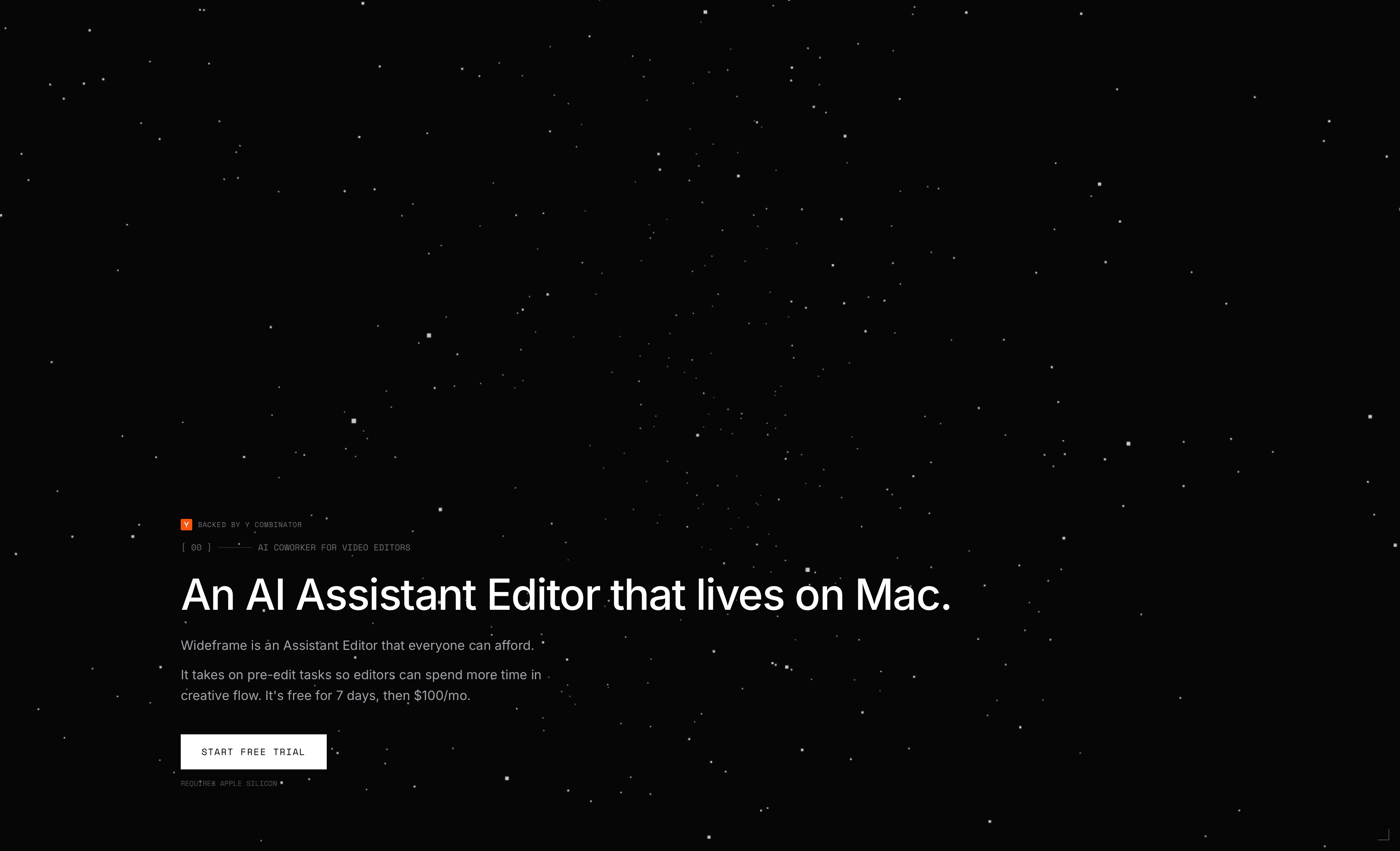
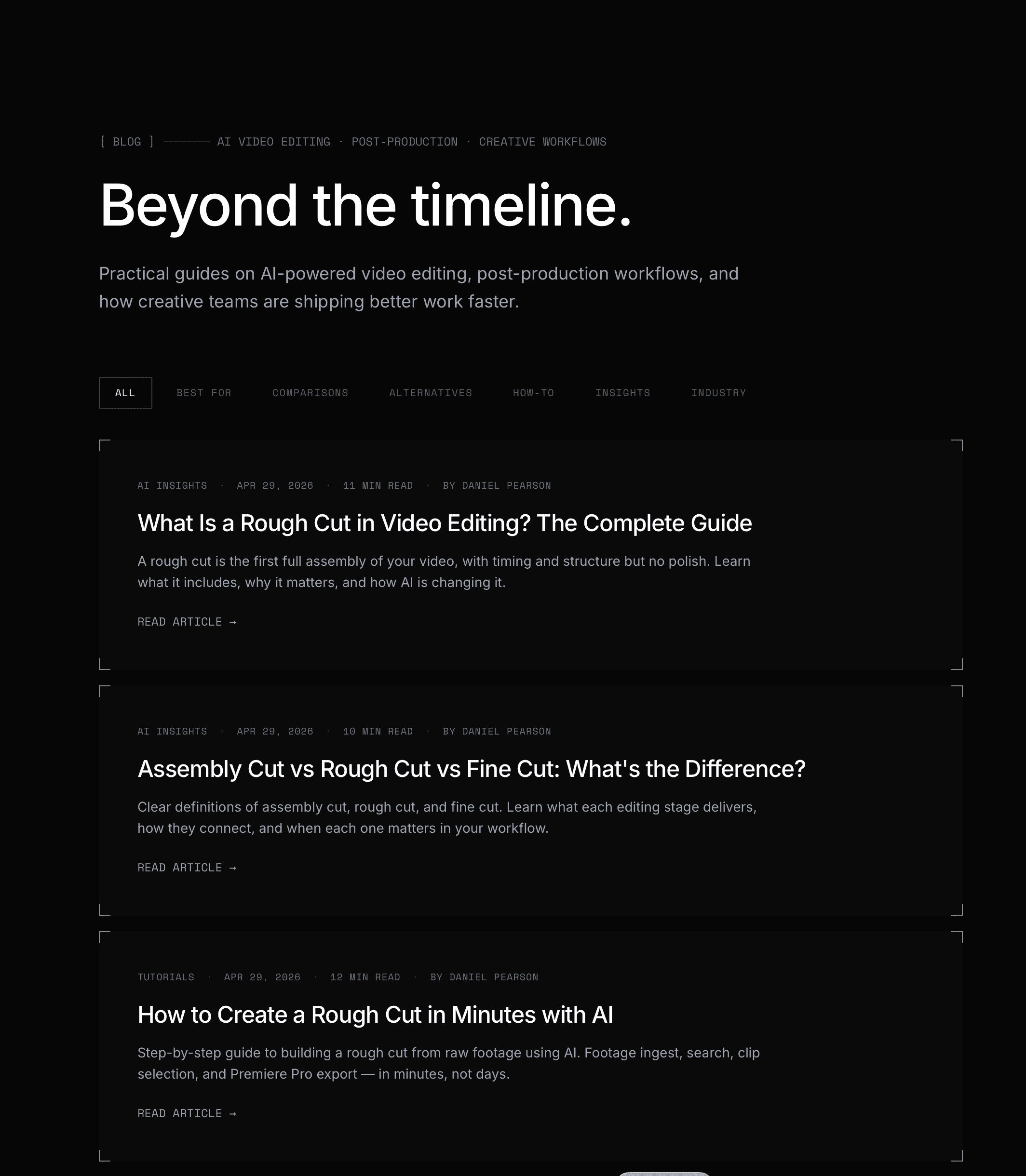
Look at the artifacts. The founders come from the performance-content world, so the defaults lean that way. The 400+ blog posts on try.wideframe.com are keyword-mining: comparisons, best-fors, alternatives, how-tos, insights, industry topics—clearly on the hunt for their TAM.
Also, they're Mac-only and have a flat 7-day-trial-to-$100-monthly-commitment pricing structure. Seems like the only one it works for is…the hyper-shipping content agency? 🤨 I feel an ick coming on.
It's not damning, but it's revealing: we're pre-PMF and it all points to the same unspoken ICP—and a crutch-cuddling instinct for what's familiar. 🩼
Breaking the Guardrails
Why mess with what already works?
The case for going all in on content/DTC isn't weak: the vertical works, it fits the playbook, and focus wins. And honestly? If I were advising for the next 90 days, I'd say lean in.
But here's the fault-line: overfit to that one ICP now and you'll happily wall yourself off from a MUCH bigger TAM that…isn't actually that far down the road. 🤔
If we dogpile on what feels safe, we'll crack our skulls against the ceiling. But if we actually open up to the world of—not just documentary—but narrative and commercial…you're looking at a legacy of industry-standard organizational flows to learn from.
That means getting Wideframe to learn how to read slates (and tail slates, which are held upside down at the end of a take), automatically sync sound to video (this would be the BIGGEST lifesaver), assemble based on uploaded scripts and director/script supervisor notes, organize with standard labeling conventions, integrate with DIT…I could go on.
All video workflows are offshoots of Big-Daddy-Cinema—getting the feedback from veteran editors provides an untapped wealth of knowledge about the best way to stay organized in prep.
And if you pick your favorite hyper-shipping product-child too early…you'll forfeit a dynasty. 🎥
The solution is to sequence the build based on real feedback from the whole of your TAM—this bridges into what I'd call product strategy. Suddenly, marketing is more than output now—it's a way to actually research the efficacy of your own product.
Defensibility: Threats and the Moat
The elephant is Adobe.
Adobe Sensei does semantic search (one of the pillars of Wideframe) and the new Firefly AI assistant (public beta, April 27, 2026) now takes natural-language commands inside Premiere. Spooky…until you realize that these tools are limited to the Adobe ecosystem: they only work POST-INGEST inside the editing software. 😳
That's excellent news for Wideframe! 💪 Because what I love most about Wideframe is also its strongest defense: it works off-device, across any drive or cloud storage, and lives on your desktop before any editing software needs to eat your footage. This means I can organize MY WAY no matter the editing tool I use.
That is the moat. Prioritize it. 🫵
WHAT'S ACTIONABLE RIGHT NOW
Give your orphans a parent.
The reflex here would be to focus on the loud vertical and run with it. But we've established how that's the favorite child trap. The first real move is to write the parent message, which is the thesis that holds whether you're shipping 50 ads a week or cutting a feature over six months.
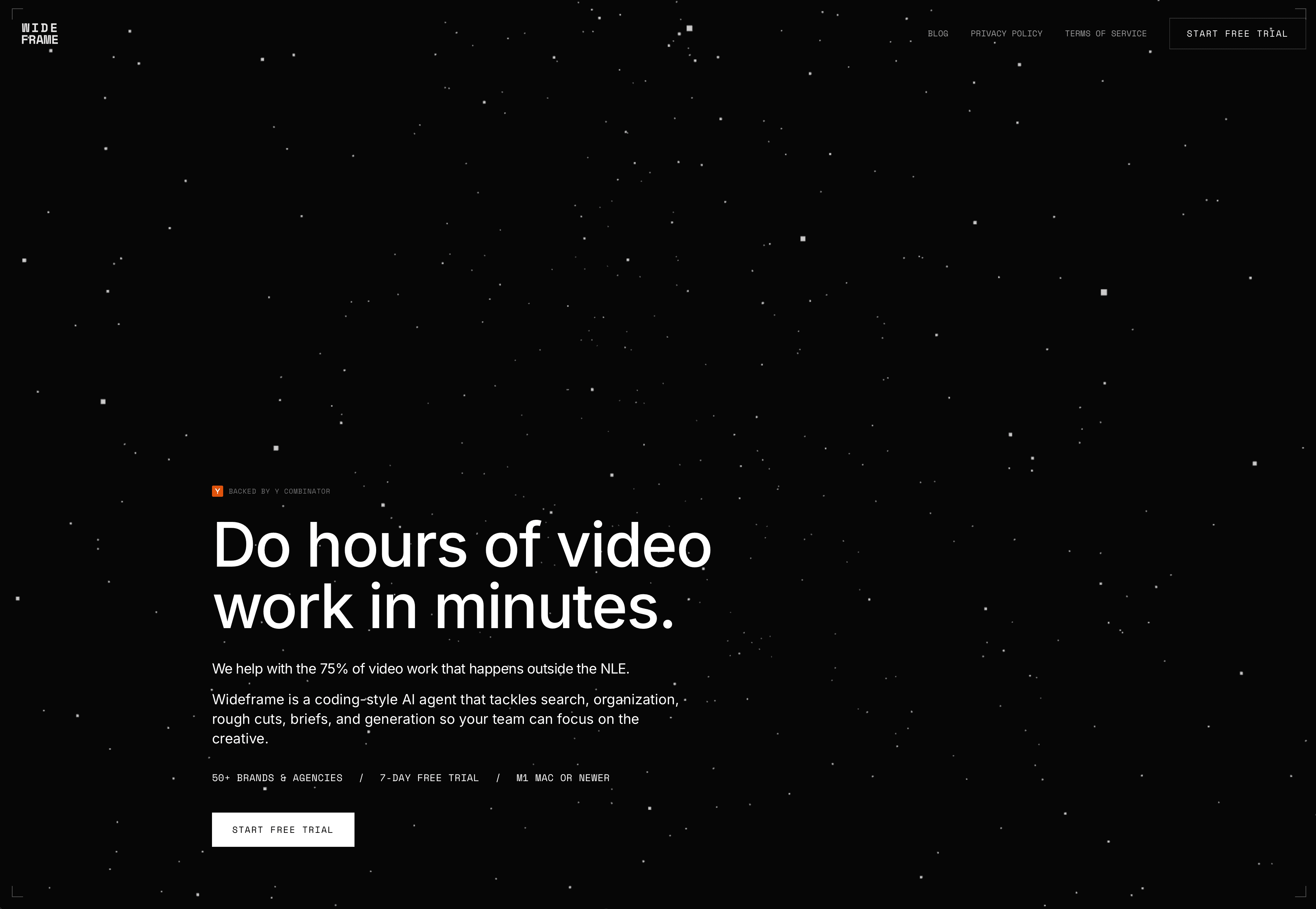
And honestly? Wideframe is close: "We help with the 75% of video work that happens outside the NLE."
But…that's investor speak. You're talking ABOUT your market here—not to them.
This is the most consistent positioning issue I see across all early-stage startups. This is because the focus is on getting funded—I know—but you have to remember: who are you building this for? The investors? Or the people whose problems you're trying to solve?
And I don't know any editor that calls their software "the NLE". We just say the name (or shorthand of the name) of what we use. Again—speak TO your market LIKE your market.
So instead, I say position around your thesis: "Editing should be editing—not prepping." And then differentiate sub-headers based on the ICP. Here is where you can test all kinds of ads and see what combination of messaging works best for your markets.
You might also try offering longer-term trials to communities of editors so you can mine their feedback and workflows—and one of the best ways to reach them is at film trade shows and festivals. You'll get a ton of interest there.
Also, expand your pricing tiers based on team size/production scale. Give people 3 weeks to try it out instead of just 1. Habits create attachment.
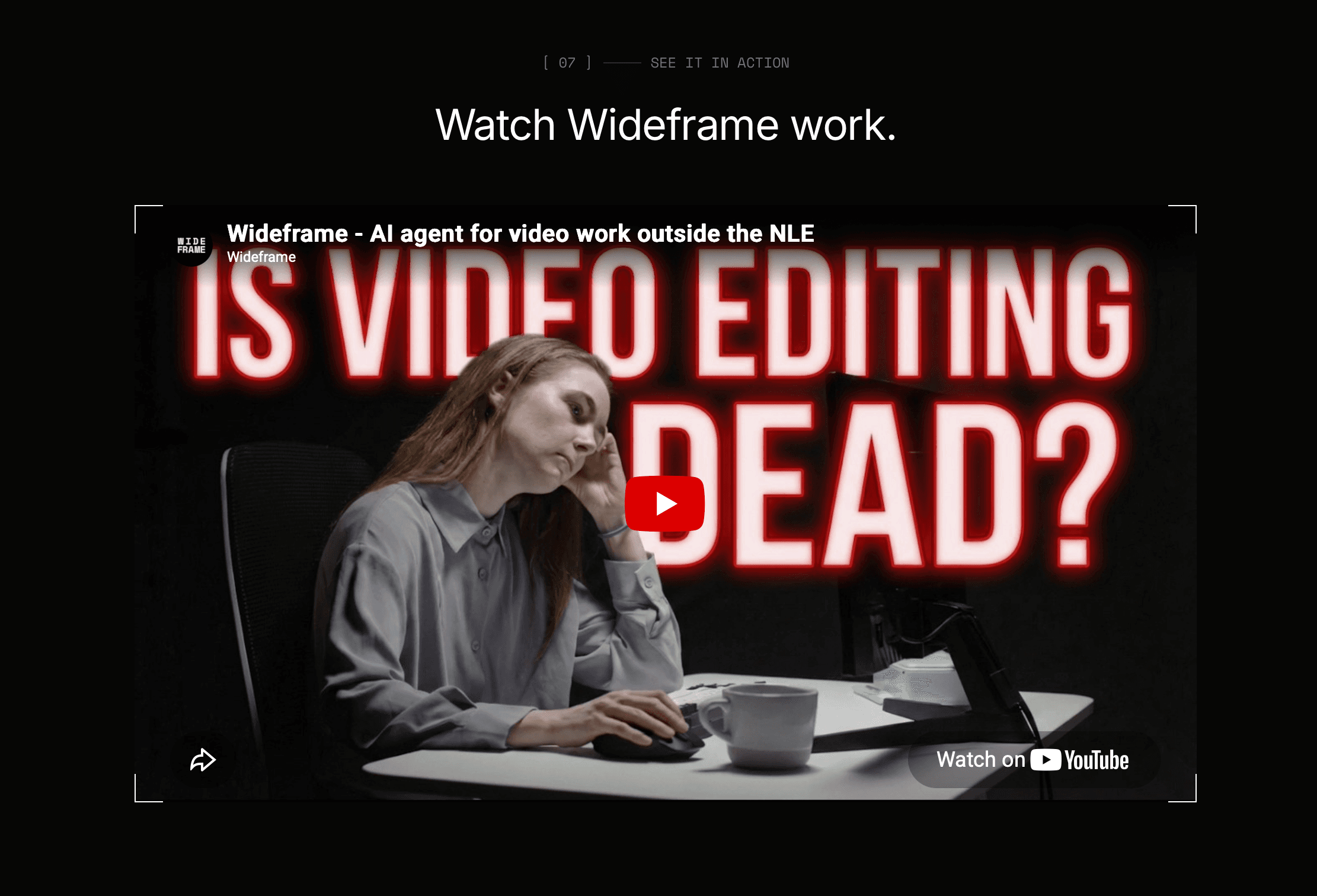
What I don't know Yet
The long-term vision for Wideframe.
I don't live inside Daniel's or Zachary's heads. I don't know if the "always-on creative strategist" is an active feature, a goal-feature, or a separate product in disguise. I don't have a visual on their metrics or retention, or whether the content-shipping ICP is pulling because it's right or just because it's loud.
The questions I'd pose to Daniel and Zachary: if forced, which ICP would you cut? And is pre-ingest core to the product forever, or is it just a wedge?
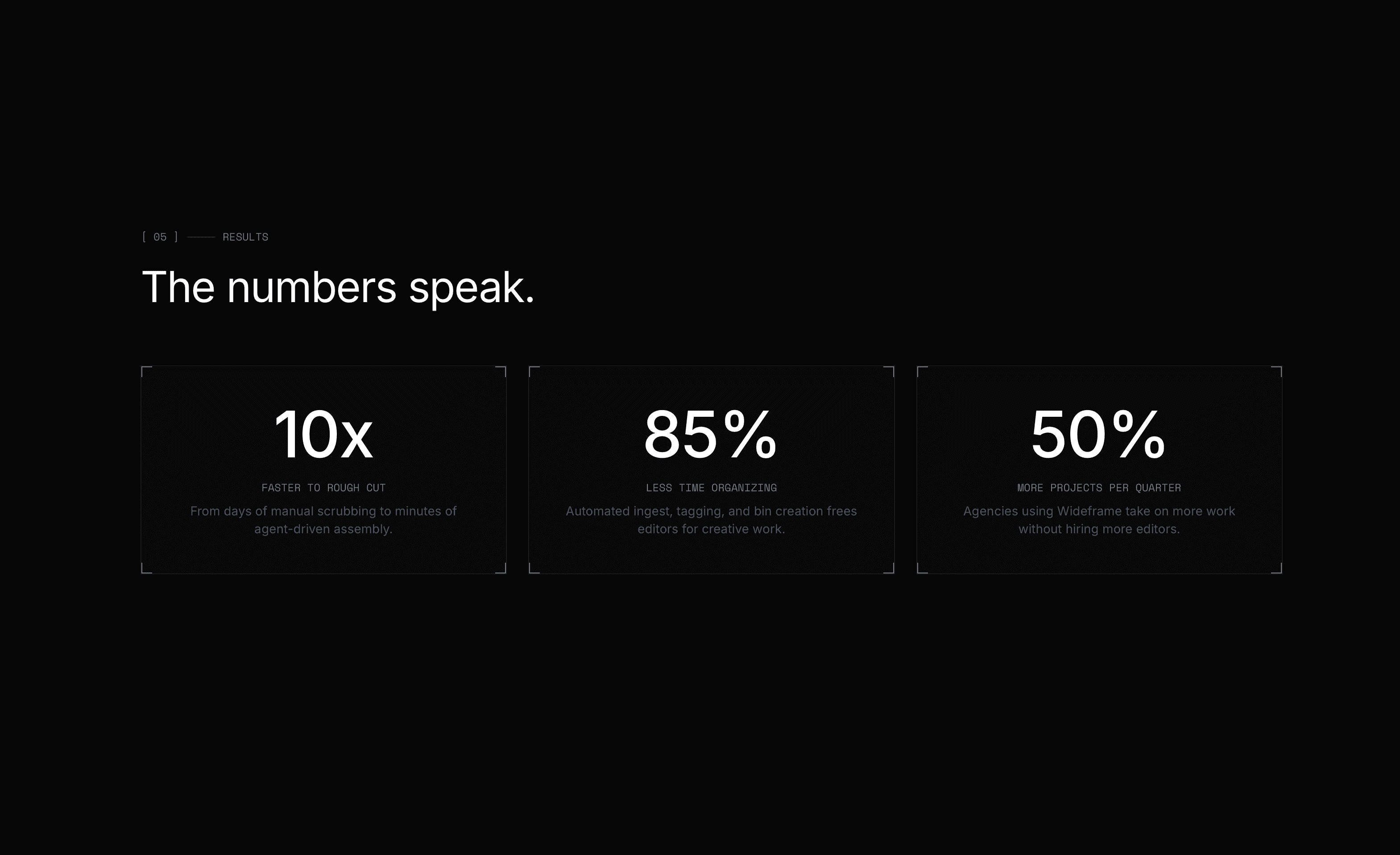
Wideframe's numbers // 10x feels more like jargon than proof these days. I'd want third-party proof on the 50%. But if 85% Less Time Organizing holds, that's A value prop in a single stat Hiding way down low on the homepage.
Shay's Take
Wideframe has a rare, genuinely respectful and admirable thesis. The founders have lived this exact pain themselves, and their moat is hiding in plain sight.
I don't think the product is holding them back—it's just the unresolved answer to "who are we for first," and a GTM strategy that's still mining for keywords when it should be planting flags.
All is fixable, nothing is fatal.
Editing should be editing—not prepping.